
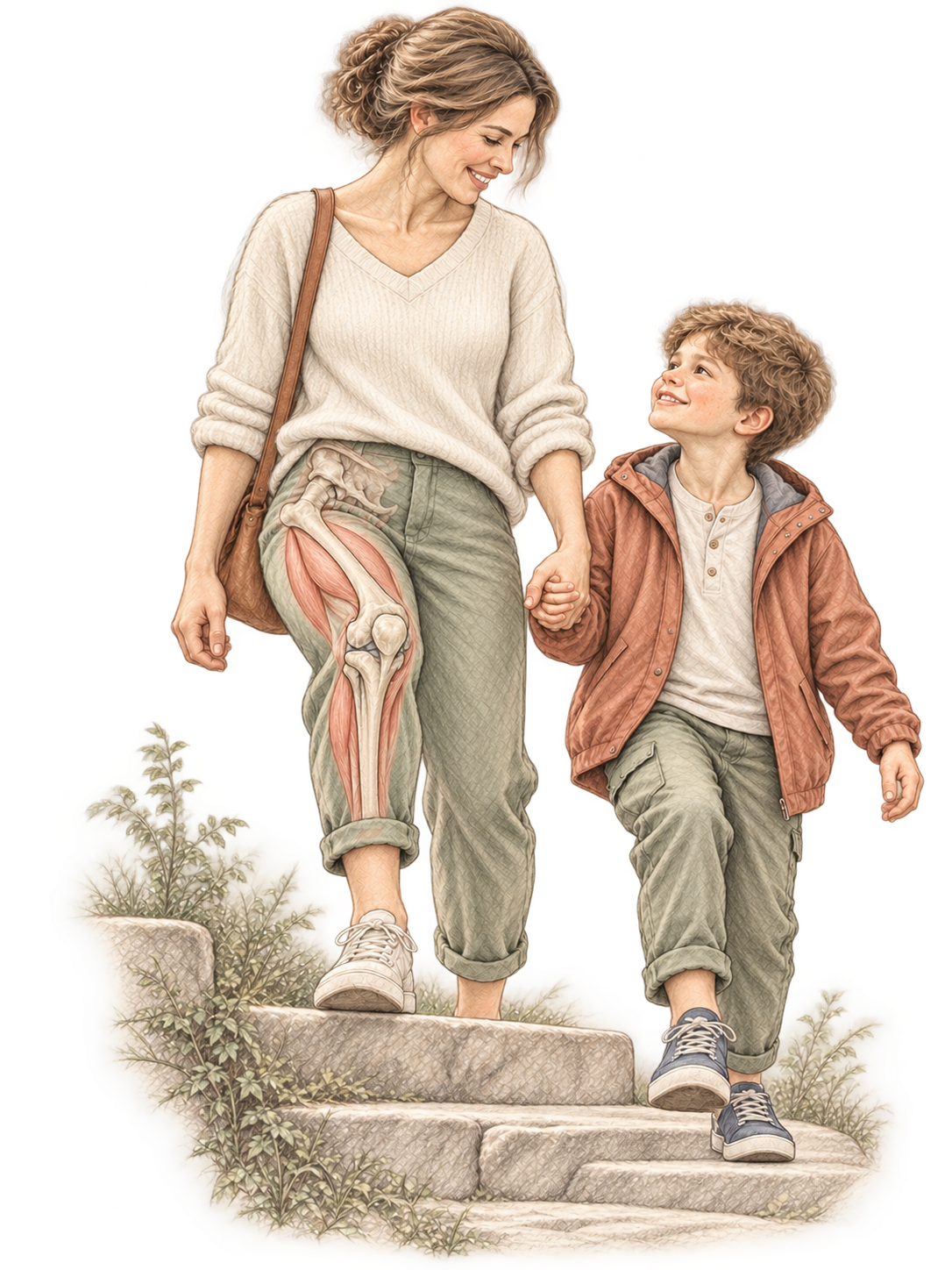
Climbing a stair requires your thigh muscles to lift you onto the next step. Coming down requires controlled braking as they take your weight. When the front of your knee hurts, it is useful to consider the whole movement system: knee, hip, pelvis, spine and nervous system work together.
What is pain at the front of the knee?
Pain around or behind the kneecap is often called patellofemoral pain. It commonly appears when the knee bends under load, such as on stairs, when standing up or during a squat. The term describes a pattern of symptoms around the joint between the kneecap and thigh bone. [1]
As the knee bends and straightens, the kneecap moves within a groove in the thigh bone. The quadriceps, the large muscle group at the front of your thigh, transmits force through the kneecap and its tendon. How comfortable that load feels depends on factors including movement, the amount of activity and muscle function.
Why your knee works with your pelvis and spine
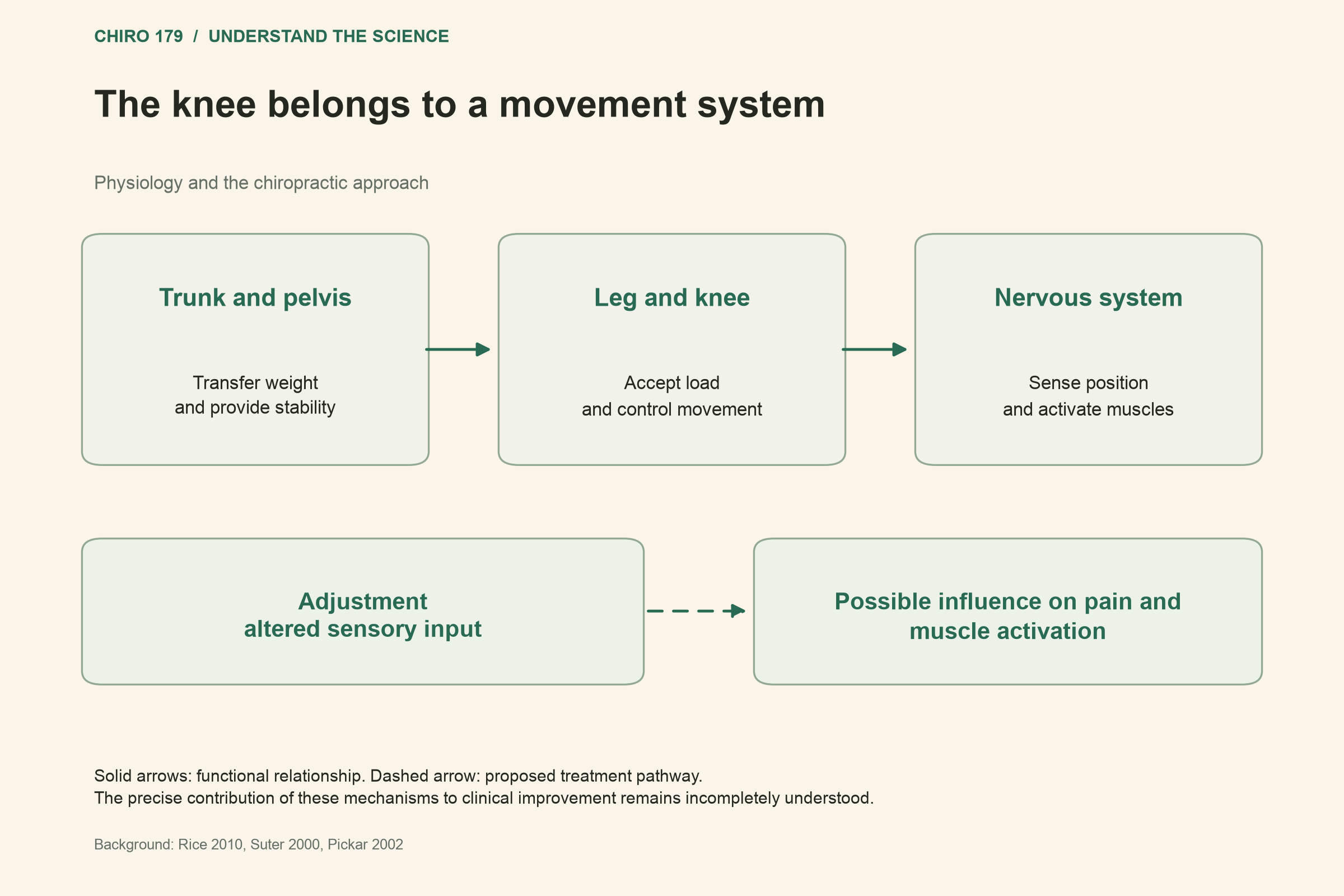
A stair is a task shared by several joints. The hip steadies the thigh, the pelvis transfers weight and the trunk controls the position of the upper body over the leg. A change in one region can change the task faced by the others.
The nervous system continuously coordinates this work. Signals from muscles and joints tell it where the leg is and how much force is needed. With painful joint problems, quadriceps activation can be reflexively inhibited. The muscle may then be harder to contract fully during a test, even without a change in its size. This phenomenon is well described in research. [2]
In everyday terms, strength also depends on how effectively a muscle is activated in a particular situation. Controlled stepping down is one task where this coordination matters.
How an adjustment fits into this system
An adjustment moves an examined joint with a brief mechanical impulse. This temporarily changes sensory information from the treated area. Researchers then measure responses in pain sensitivity, muscle activation and position sense. [3] [4]
For pain at the front of the knee, a chiropractic examination can therefore include the hip, pelvis and lower back. One proposed pathway is that altered sensory feedback and less pain make muscle activity easier. Small studies have measured less quadriceps inhibition after pelvic adjustments. That describes a short-term activation response; the full explanation of longer-term clinical improvement remains open. [5]
The functional goal is more comfortable loading: climbing stairs, standing up and walking with confidence.
Why your own stairs are a useful measure
At CHIRO 179, we consider movement, symptoms and the task you want to make easier. A particular staircase or standing up from your favourite chair provides a meaningful reference point. These activities help show whether a change makes a difference in daily life.
A focused view of the movement system is an important part of the chiropractic approach. Research on patellofemoral pain provides practical reasons to examine these connections.
What studies show
Less pain and better knee function after six weeks
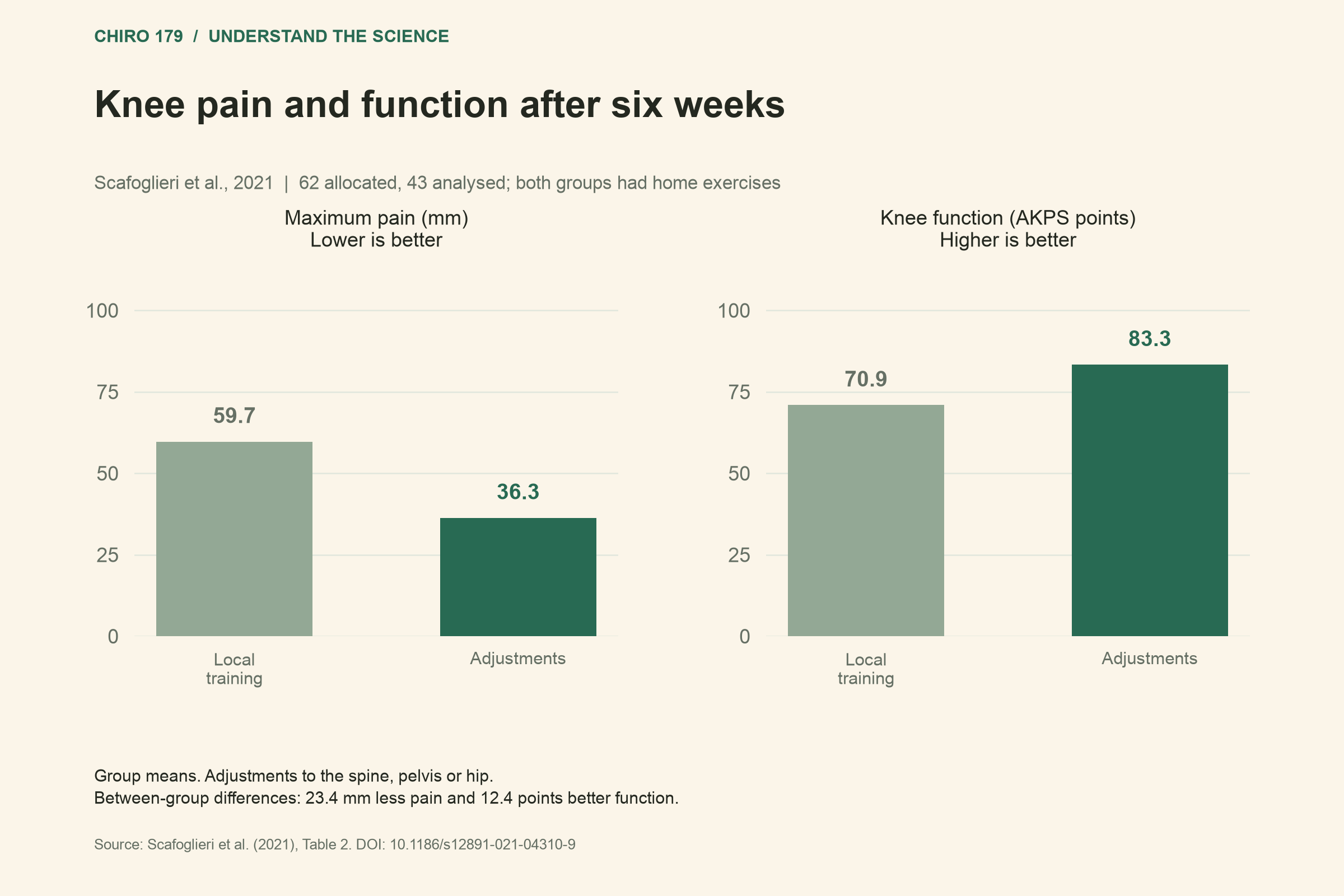
A randomized trial with 62 people allocated and 43 analysed compared spine, pelvis or hip adjustments with local training; both groups received home exercises. At six weeks, maximum pain was 23.4 millimetres lower and knee function 12.4 points higher in the adjustment group. Both scales run from 0 to 100. [6]
Position sense and muscle activation
A randomized study of 44 participants found an immediate reduction in knee pain and more accurate reproduction of a knee position at 60 degrees of bending after a lower-back and pelvic adjustment. [7]
A controlled study involving 28 people measured less quadriceps inhibition after pelvic adjustment. [5] Another randomized study of 28 athletes reported short-term improvements in pain and step-down performance. [8]
Make everyday steps more comfortable
Would you like to use stairs with more confidence or enjoy a longer walk? At CHIRO 179 in Korntal and Böblingen, we consider your knee within the wider movement system. Book an appointment and share this article with someone whose knee often makes everyday activities uncomfortable.
Related guides
Arm tingling: how the neck, nerves and chiropractic adjustments connect · Jaw pain and TMD: how your jaw, neck and nervous system work together
Sources and studies
- AAOS: Patellofemoral pain
- Rice & McNair, 2010: Arthrogenic quadriceps inhibition
- Pickar, 2002: Neurophysiology of adjustment
- Bialosky et al., 2009: Experimental pain sensitivity
- Suter et al., 2000: Quadriceps inhibition after pelvic adjustment
- Scafoglieri et al., 2021: Six weeks of care for patellofemoral pain
- Motealleh et al., 2020: Knee pain and position sense
- Motealleh et al., 2016: Pain during a step-down task