
Eating a crusty roll, yawning or enjoying a long conversation all depend on comfortable jaw movement. When chewing hurts or opening your mouth becomes difficult, those small moments matter. Chiropractic care also considers the neck because jaw movement, head position and muscle control work together.
What is TMD?
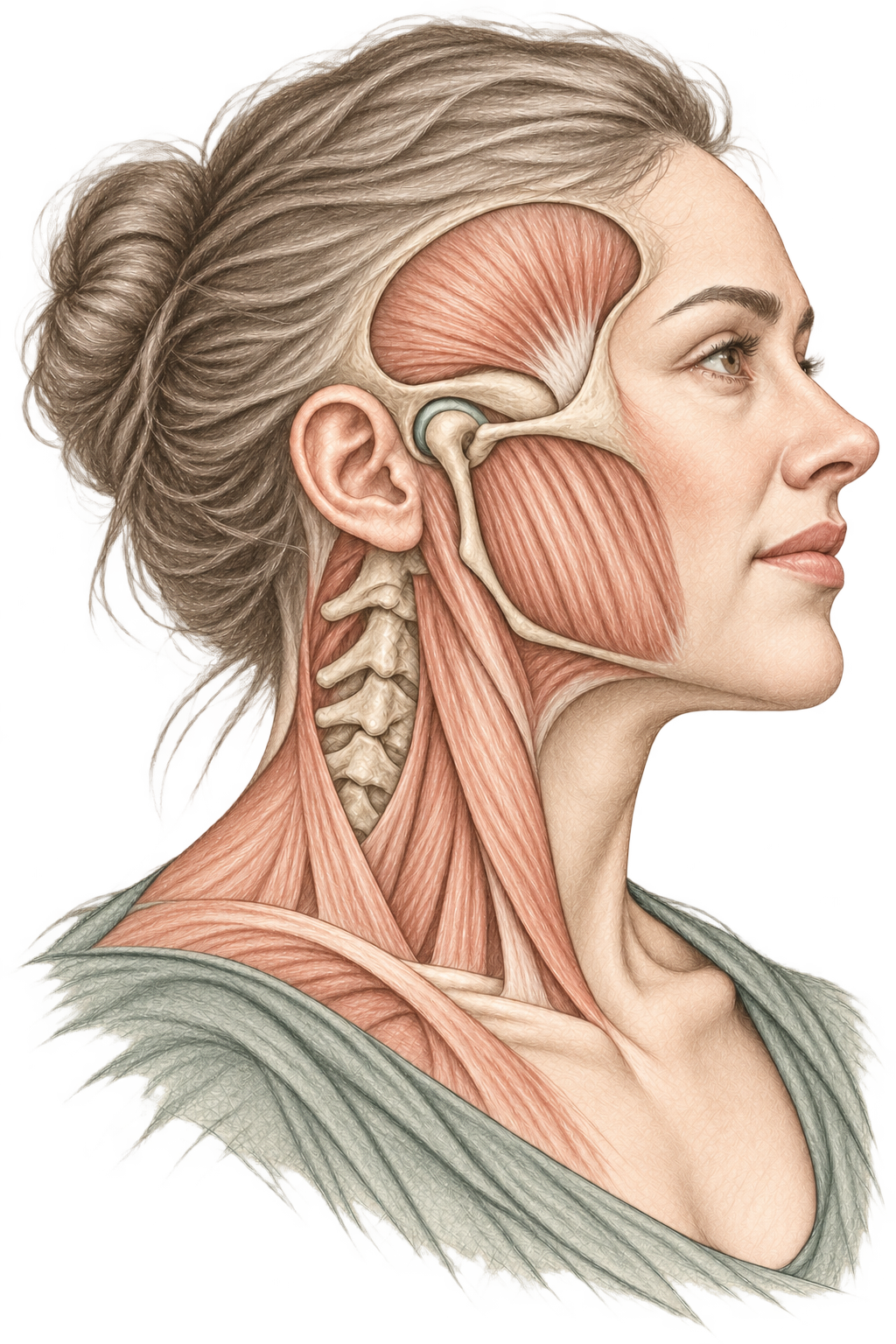
Temporomandibular disorders, or TMD, are conditions affecting the jaw joints and chewing muscles. The joints connect the lower jaw to the skull. A small disc supports joint movement, while several muscles coordinate the direction and force used to open, close and chew.
With TMD, these movements can become painful or restricted. Symptoms may include pain when chewing, tender chewing muscles or limited mouth opening. A clicking joint on its own does not necessarily mean a painful disorder. What matters is how your jaw moves and feels in daily life. [1]
Why your neck joins in when you chew
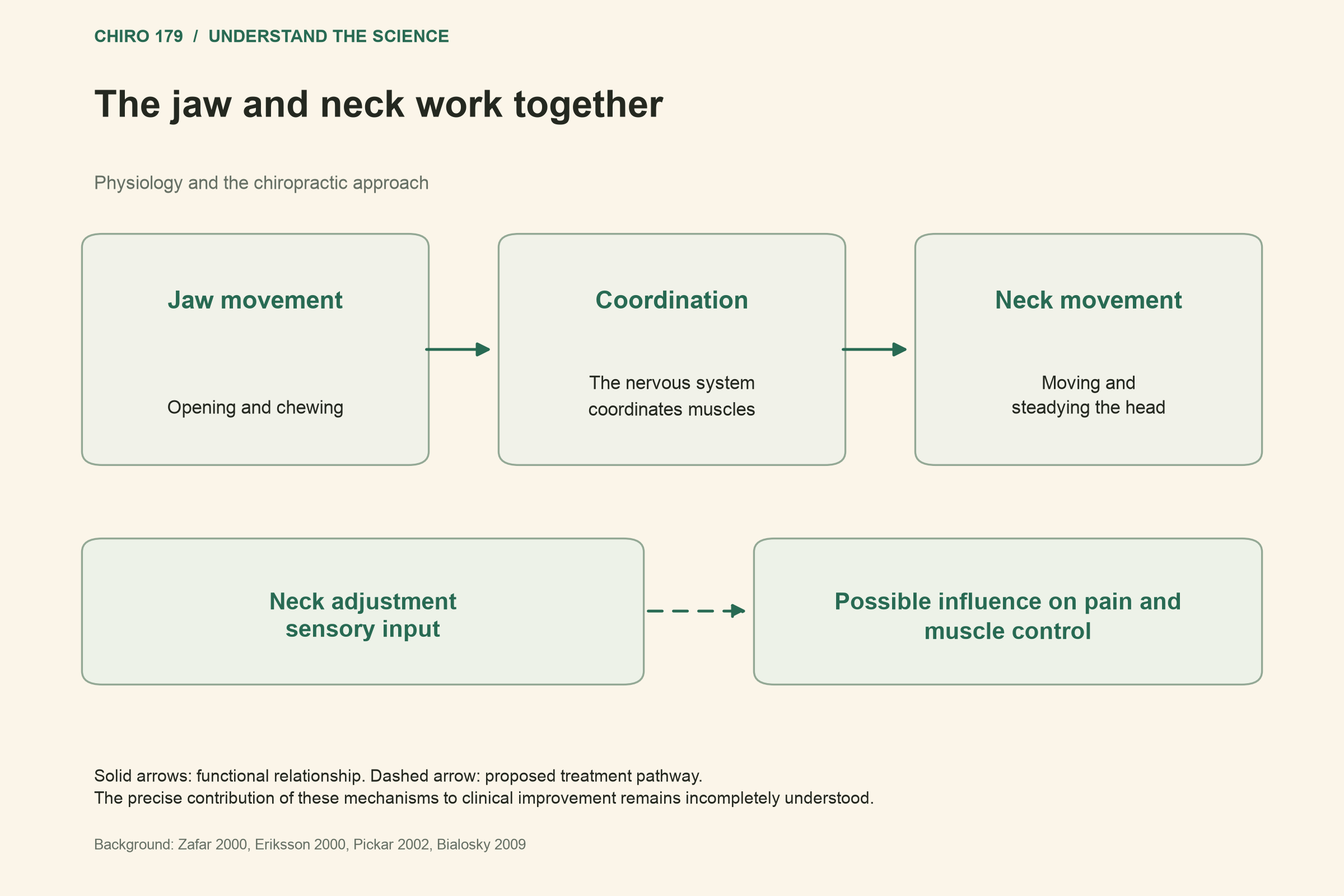
Open your mouth widely and your head often moves slightly too. Neck muscles steady the skull while the chewing muscles guide the lower jaw. Neck movement and muscle tension therefore form part of the jaw’s functional surroundings.
The nervous system coordinates this teamwork. Sensors in muscles and joints report movement and load. The brain uses that feedback to adjust the next movement. Pain can also change muscle activity and the way a movement is performed. When jaw and neck pain occur together, both regions deserve attention. Movement studies have directly measured their coordination. [2] [3]
How an adjustment fits into this system
An adjustment is a brief, controlled mechanical impulse applied to an examined joint. The movement also loads surrounding tissues and temporarily changes their sensory input. Research models describe how this input could influence pain processing and muscle control. [4] [5]
For jaw symptoms accompanied by neck problems, the chiropractic approach focuses on neck movement, discomfort and the way the regions work together. One possible explanation for easier mouth opening is that less neck pain and altered muscle tension make movement more comfortable. The exact contribution of each mechanism to a person’s improvement remains incompletely understood.
The practical goal is more comfortable movement: opening your mouth more easily, chewing comfortably and turning your head with greater freedom. These are useful functions to track over time.
What a focused approach means
We consider which movements bring on symptoms, how far the mouth opens and how head and jaw movement accompany each other. This helps identify which region may be appropriate for an adjustment. Your movement pattern and meaningful changes in everyday activities guide the plan.
A shared meal, a long conversation or biting into an apple gives that goal a practical meaning. Chiropractic care considers the relationship between joint movement, muscles and the nervous system.
What studies show
Less jaw pain after six treatment sessions
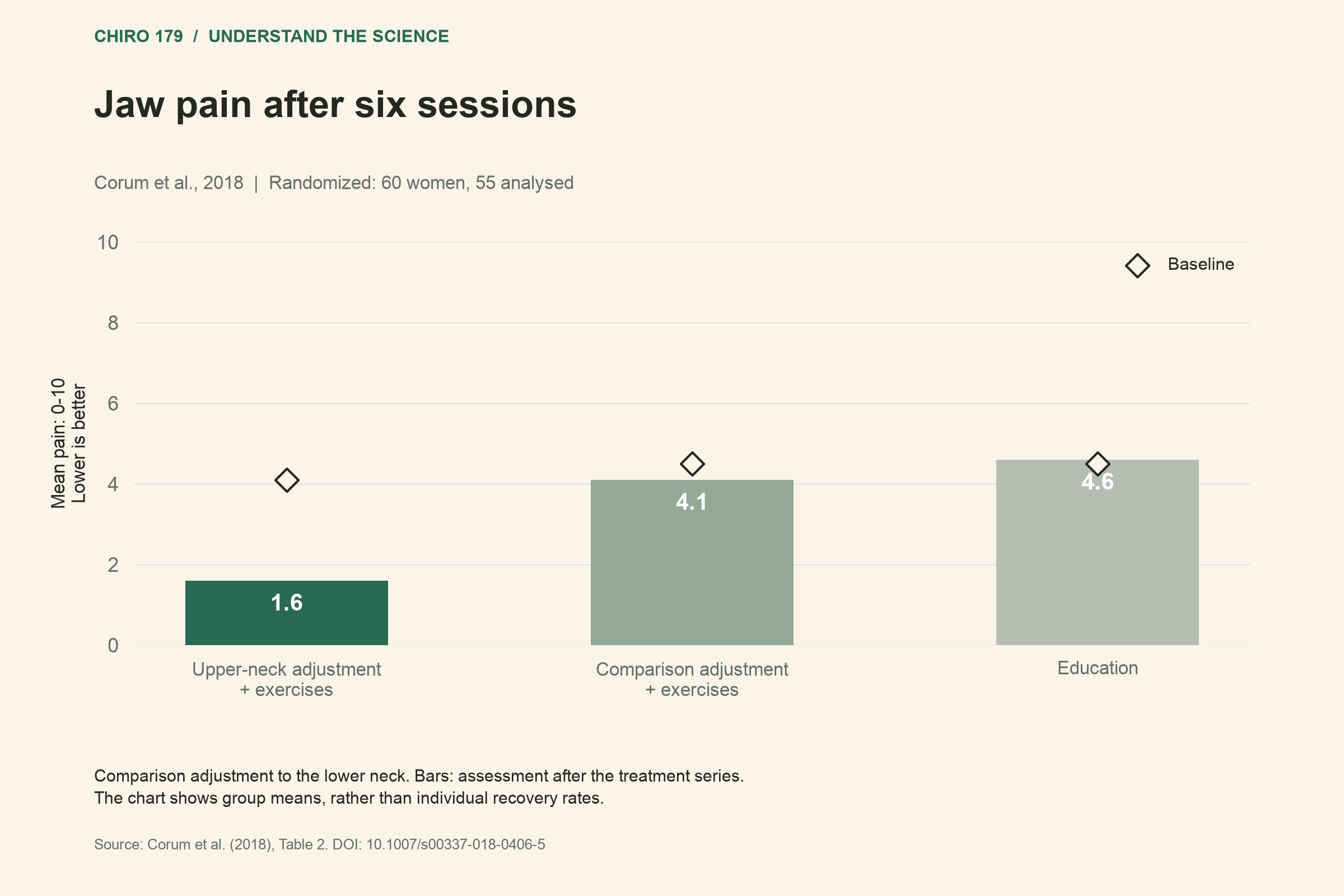
In a randomized trial of 60 women, with 55 analysed, mean jaw pain fell from 4.1 to 1.6 out of 10 after upper-neck adjustments plus exercises. After comparison adjustments to the lower neck plus exercises, it was 4.1; after education, 4.6. These are the measurements following six sessions. [7]
Mouth opening and movement coordination
A randomized trial involving 37 women with neck pain found greater active mouth opening five minutes after an upper-neck adjustment than after a control contact. [6]
Movement studies involving 24 and twelve healthy participants, respectively, also demonstrated coordination between head and jaw during opening and chewing. These explain the functional connection; the first study examines a short-term treatment response. [2] [3]
Make meals and conversations more comfortable
At CHIRO 179 in Korntal and Böblingen, your everyday goals guide our examination of jaw function and the neck. If you would like to chew more comfortably and move your neck more freely, book an appointment. Share this article with someone whose jaw or neck symptoms sound familiar.
Related guides
Dizziness and the neck: understanding balance, the nervous system and chiropractic care · Arm tingling: how the neck, nerves and chiropractic adjustments connect
Sources and studies
- NIDCR: Temporomandibular disorders
- Zafar et al., 2000: Coordination of jaw and head
- Eriksson et al., 2000: Jaw-neck coordination during chewing
- Pickar, 2002: Neurophysiology of adjustment
- Bialosky et al., 2009: Model of pain modulation
- Mansilla-Ferragut et al., 2009: Mouth opening after upper-neck adjustment
- Corum et al., 2018: Adjustment and exercise for chronic TMD