
Your hand tingles while typing, carrying a bag becomes uncomfortable or symptoms travel from the neck towards the fingers. These sensations show how closely arm function and the nervous system are linked. The neck is an important connection point.
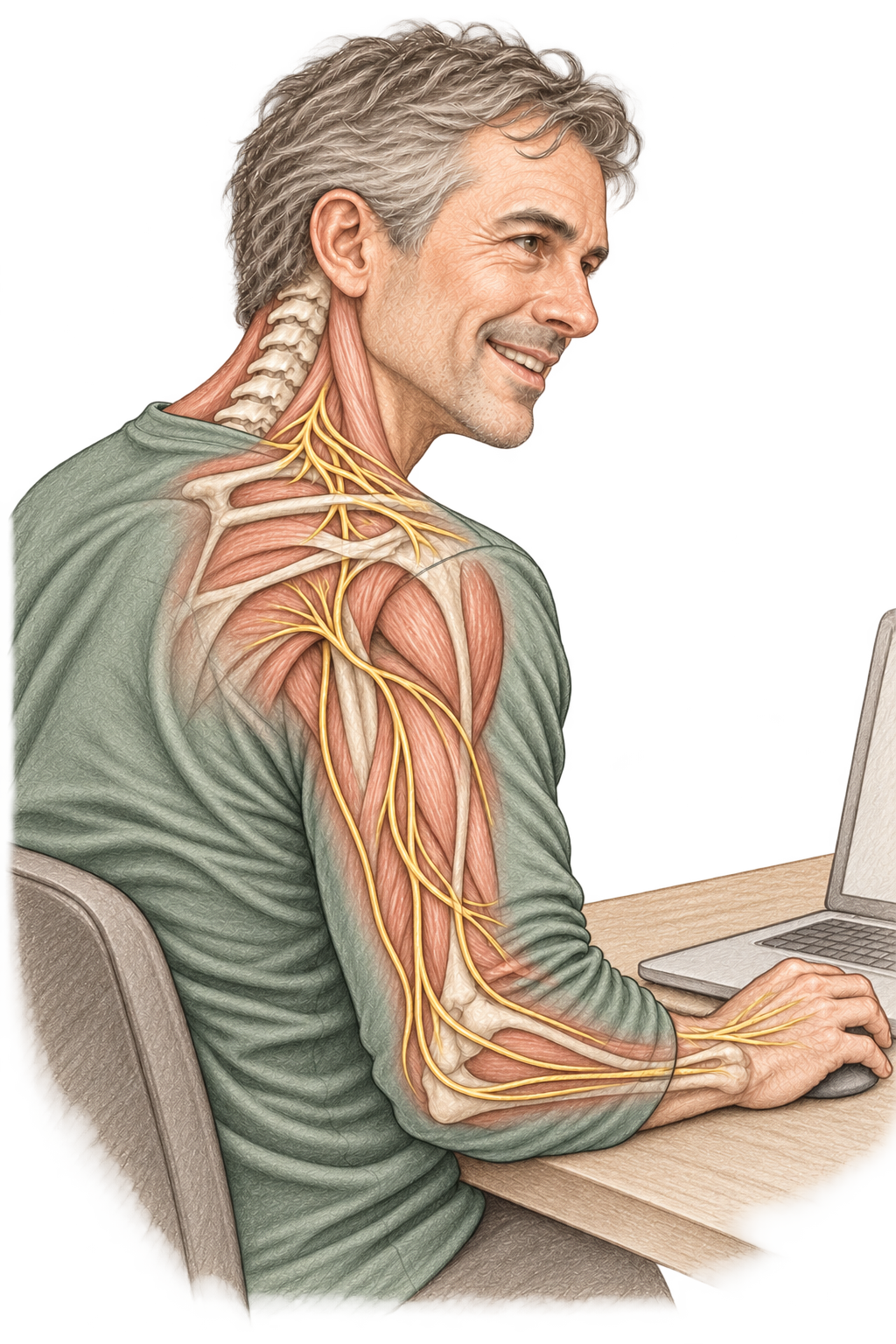
What is tingling in the arm?
Tingling is an altered sensation. It can feel like pins and needles, small electric sensations or a patch that has fallen asleep. Irritation of a nerve root in the neck can produce radiating pain, tingling, numbness or changes in strength alongside neck pain. This pattern is called cervical radiculopathy. [1]
Arm tingling can also arise elsewhere along a nerve’s course. This article focuses on symptoms associated with an irritated nerve root in the neck.
How the neck connects to the arm
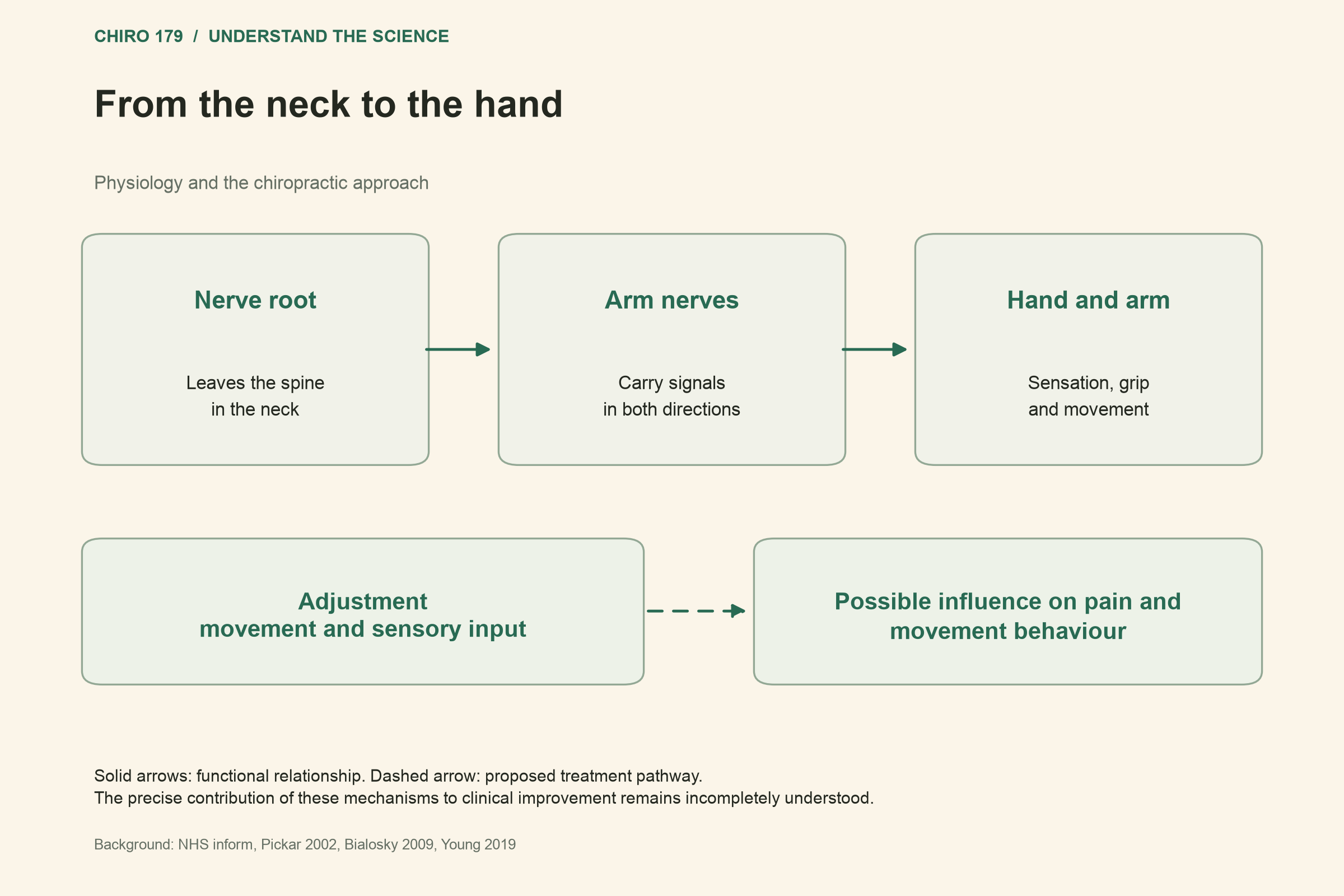
Nerve roots leave the spine through openings between the neck vertebrae. Their fibres join to form nerves supplying the shoulder, arm and hand. Some fibres carry touch and other sensory information towards the nervous system; others carry signals to muscles.
Irritation near a nerve root can therefore be felt some distance away. Mechanical pressure and inflammatory processes can both play a part. Which fingers are affected and how movement changes symptoms help describe the pattern. [1]
The neck and upper back also work together during head movement. Turning or lifting your head distributes movement and load across several regions. This helps explain why a chiropractic approach may also consider the thoracic spine, or upper back.
How an adjustment fits into this system
An adjustment applies a brief mechanical impulse to an examined joint. It moves tissues and produces sensory feedback. Proposed pathways include changes in pain processing, muscle activity and movement behaviour. [2] [3]
With radiating symptoms, useful questions include whether head movement becomes more comfortable and whether the distribution of symptoms changes. A thoracic adjustment has been examined directly in a clinical trial. Its findings describe changes in symptoms and function; they do not demonstrate an anatomical change in a disc or nerve root. [4]
This explains the functional approach. We track movement, sensation, strength and the location of symptoms. These observations describe progress more clearly than a general feeling of being looser.
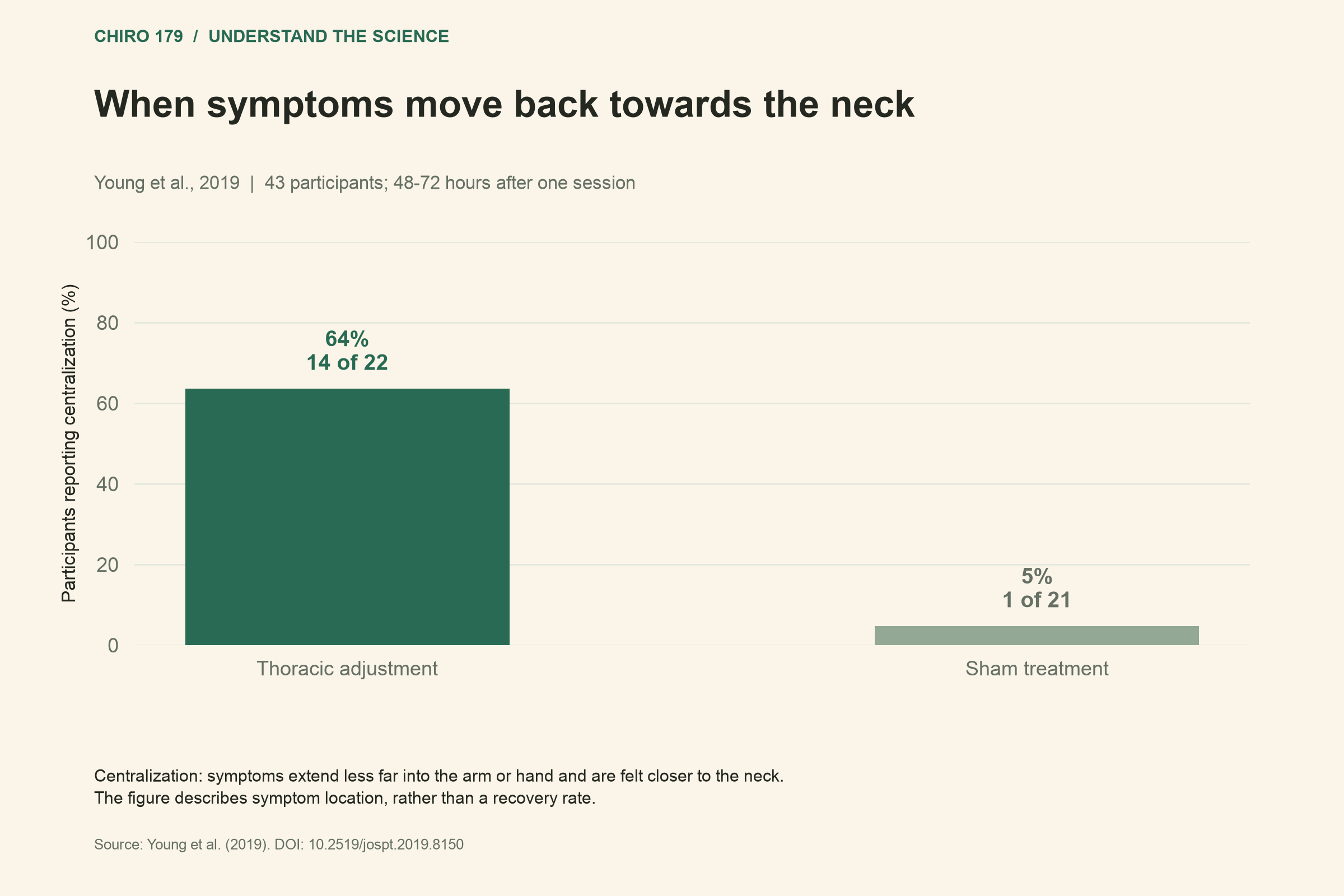
What does it mean when symptoms move back towards the neck?
Some people notice that symptoms no longer travel as far into the hand or forearm and instead become concentrated closer to the neck. Researchers call this centralization. The term describes symptom location. It does not automatically mean that all symptoms have disappeared.
Other changes matter too: working comfortably for longer, turning your head more easily while driving or carrying a bag with greater confidence. These goals give progress a practical meaning.
What studies show
Symptoms moved towards the neck more often
A randomized trial involving 43 people with cervical radiculopathy compared a thoracic adjustment with sham treatment. After 48 to 72 hours, 14 of 22 people, about 64 percent, reported centralization, compared with one of 21, about five percent, after sham treatment. Neck pain and some function tests also improved more. [4]
Clinical progress, arm strength and body awareness
In an observational study of 50 people with MRI-confirmed cervical disc herniation, 85.7 percent reported improvement after three months of chiropractic care. The study had no control group. [5]
A small before-and-after study involving 16 people with neck pain measured an immediate increase in elbow-flexor force. [6] Another laboratory study examined elbow position sense and found improvements after neck adjustment in certain test positions. These results address additional questions about function. [7]
Use your arm with greater confidence
At CHIRO 179 in Korntal and Böblingen, we consider your symptoms alongside neck movement and arm function. Book an appointment to explore that relationship. If someone you know has similar symptoms, share this article with them.
Related guides
Chiropractic care and muscle strength: how the nervous system, control and reaction work together · Dizziness and the neck: understanding balance, the nervous system and chiropractic care
Sources and studies
- NHS inform: Cervical radiculopathy
- Pickar, 2002: Neurophysiology of adjustment
- Bialosky et al., 2009: Model of pain modulation
- Young et al., 2019: Thoracic adjustment for cervical radiculopathy
- Peterson et al., 2013: Outcomes in cervical disc herniation
- Suter & McMorland, 2002: Elbow-flexor force in neck pain
- Haavik & Murphy, 2011: Elbow position sense