
Lifting a heavy bag, taking a quick recovery step or keeping your back steady during a longer task requires strength, endurance and a well-timed response. Performance also depends on how the nervous system and muscles work together. Chiropractic research examines this connection.

How do muscles produce force?
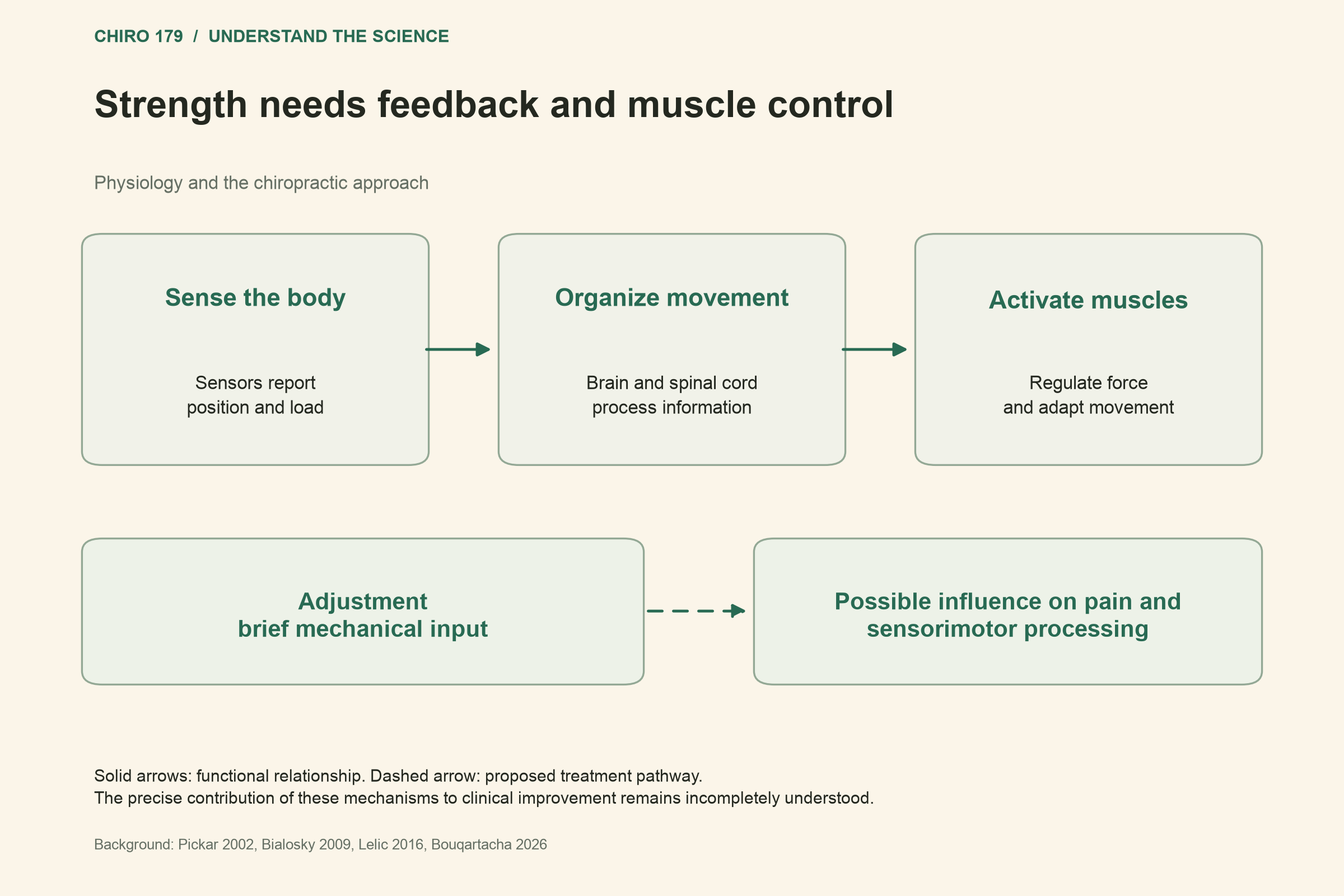
For a muscle to produce force, nerve cells send signals to its fibres. A nerve cell and the muscle fibres it supplies form a motor unit. The nervous system can recruit more motor units and change how frequently they receive signals. This helps match force to the task.
At the same time, feedback arrives from muscles, tendons, joints, eyes and balance organs. It helps regulate movement and make timely corrections. As you lift a bag, the body continually updates its estimate of the load.
Pain can change this organization. A movement may become more guarded, muscles may work together differently and available force may be harder to express during a test. Muscle size, activation, symptoms and practice all influence performance. [1] [2]
What role does the spine play?
The spine supports and moves the trunk. Its joints and surrounding muscles also provide sensory information. When you lift, walk or turn, the nervous system coordinates trunk position with movements of the arms and legs.
This feedback loop makes the connection between spinal function and movement control interesting. A physical stimulus can temporarily change the processing of sensory information. Laboratory and clinical studies examine whether and how these changes relate to performance. [4]
How an adjustment fits into this system
An adjustment applies a brief mechanical impulse to an examined joint. Sensory input and muscular responses can then be measured. A recent study recorded different immediate muscle responses during an adjustment and slower joint mobilization. This demonstrates a measurable response to the stimulus; it does not establish lasting strength gains. [3]
Proposed pathways include altered pain processing and sensorimotor processing. Sensorimotor means receiving body information and using it to organize movement. Less pain-related guarding could also make a task easier. A strength test alone cannot identify the precise cause of a performance difference.
The chiropractic approach focuses on movement and function. Strength, endurance and reaction time are separate measures, each describing a different practical demand.
Four weeks with and without chiropractic care: what does the comparison mean?
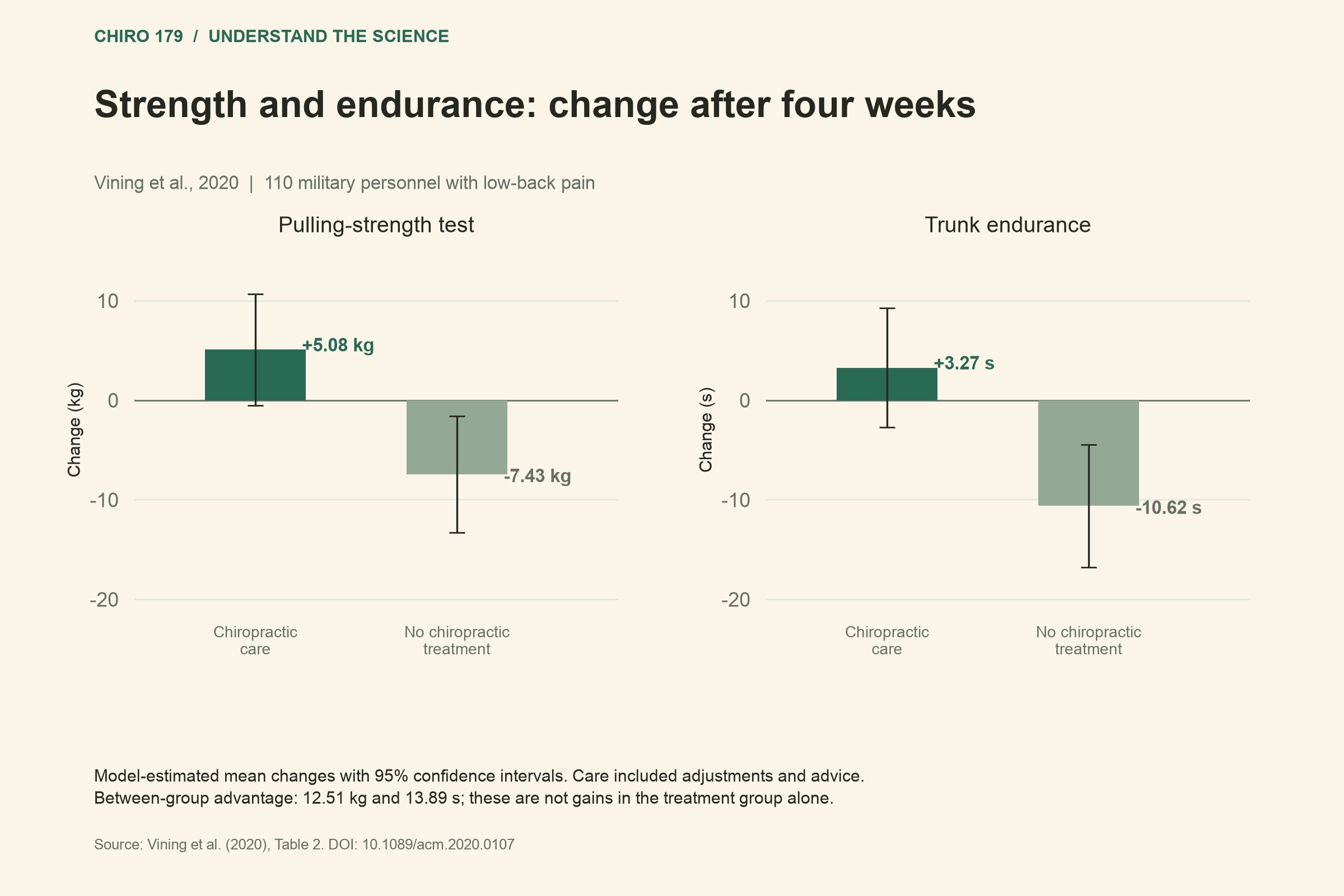
In the study illustrated below, one group received four weeks of chiropractic care including adjustments and advice. The comparison group received no chiropractic treatment during those four weeks. They could receive that care after the study period. A “waiting list” meant delayed access, rather than a particular treatment. [5]
The chart therefore uses the direct labels “Chiropractic care” and “No chiropractic treatment”. It also shows how each group changed from its own starting value. This makes the difference at follow-up easier to understand.
What studies show
Pulling strength and trunk endurance after four weeks
A randomized study involving 110 military personnel with low-back pain found a between-group advantage of 12.51 kilograms in a pulling-strength test and 13.89 seconds in a trunk-endurance test favouring chiropractic care after four weeks. The chart shows both groups’ changes and their uncertainty. These differences are not gains within the treated group alone. [6]
Reacting faster to a stepping signal
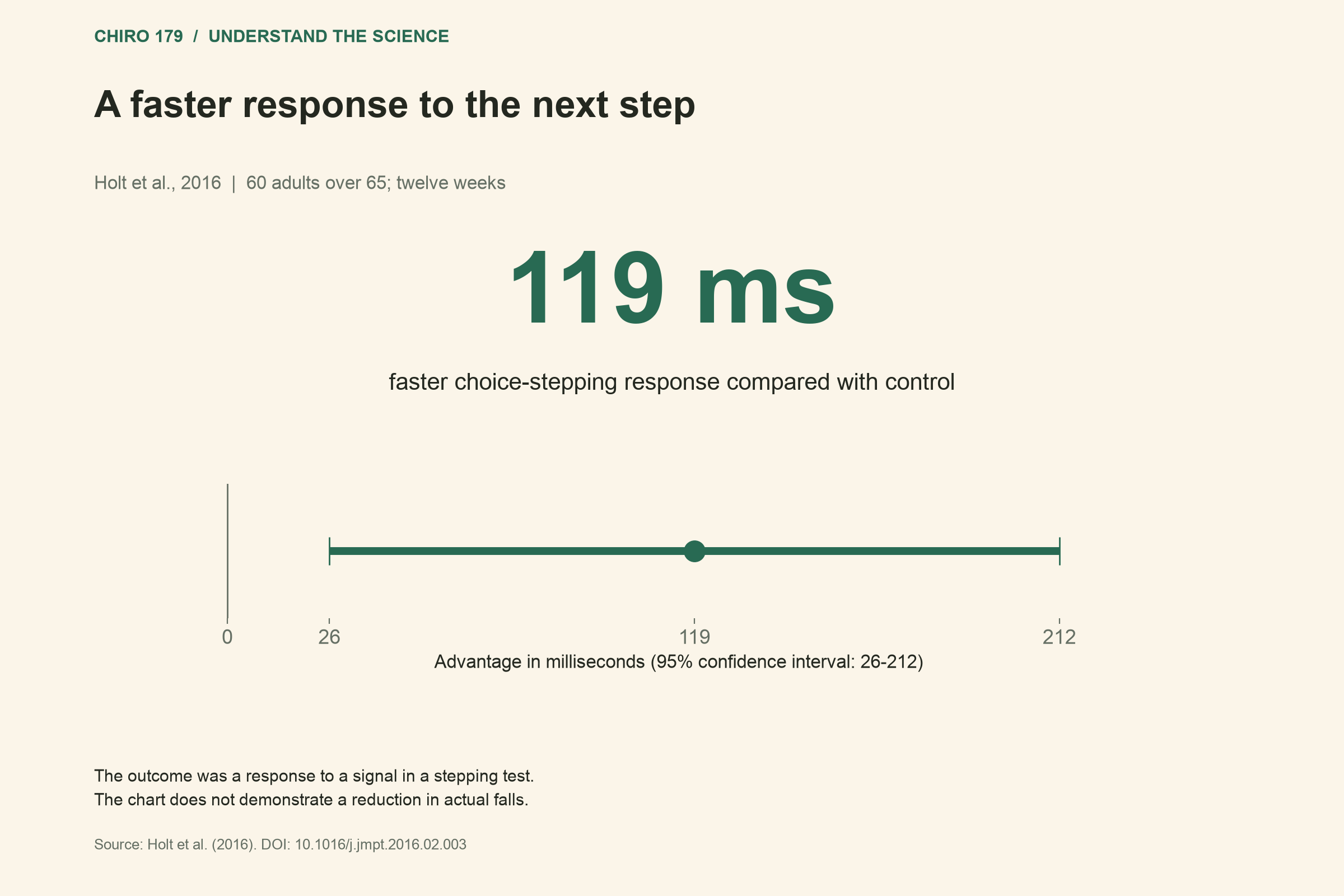
In a randomized study of 60 independently living adults over 65, twelve weeks of chiropractic care improved choice-stepping reaction time by 119 milliseconds compared with the control group. This was a test response; the figure does not demonstrate a reduction in actual falls. [7]
Immediate strength testing in athletes
A small crossover study involving eleven taekwondo athletes tested force while pressing the foot down immediately after an adjustment. It reported a short-term force increase. This adds to research on muscle control; it did not demonstrate muscle growth. [8]
Strength for the activities that matter to you
At CHIRO 179 in Korntal and Böblingen, your everyday tasks guide the discussion: lifting, carrying, staying comfortably active or responding with confidence. Book an appointment to explore spinal function and movement together. Share this article with someone interested in chiropractic care, strength and the nervous system.
Related guides
Jaw pain and TMD: how your jaw, neck and nervous system work together · Knee pain on stairs: how the spine, pelvis and muscle control play a part
Sources and studies
- Pickar, 2002: Neurophysiology of adjustment
- Bialosky et al., 2009: Model of pain modulation
- Bouqartacha et al., 2026: Immediate neuromuscular responses
- Lelic et al., 2016: Laboratory sensory processing
- Vining et al., 2018: Trial design and delayed care
- Vining et al., 2020: Strength and endurance after four weeks of chiropractic care
- Holt et al., 2016: Choice-stepping reaction time
- Christiansen et al., 2018: Immediate strength testing in athletes